
How AI is Revolutionizing Software Development and Testing
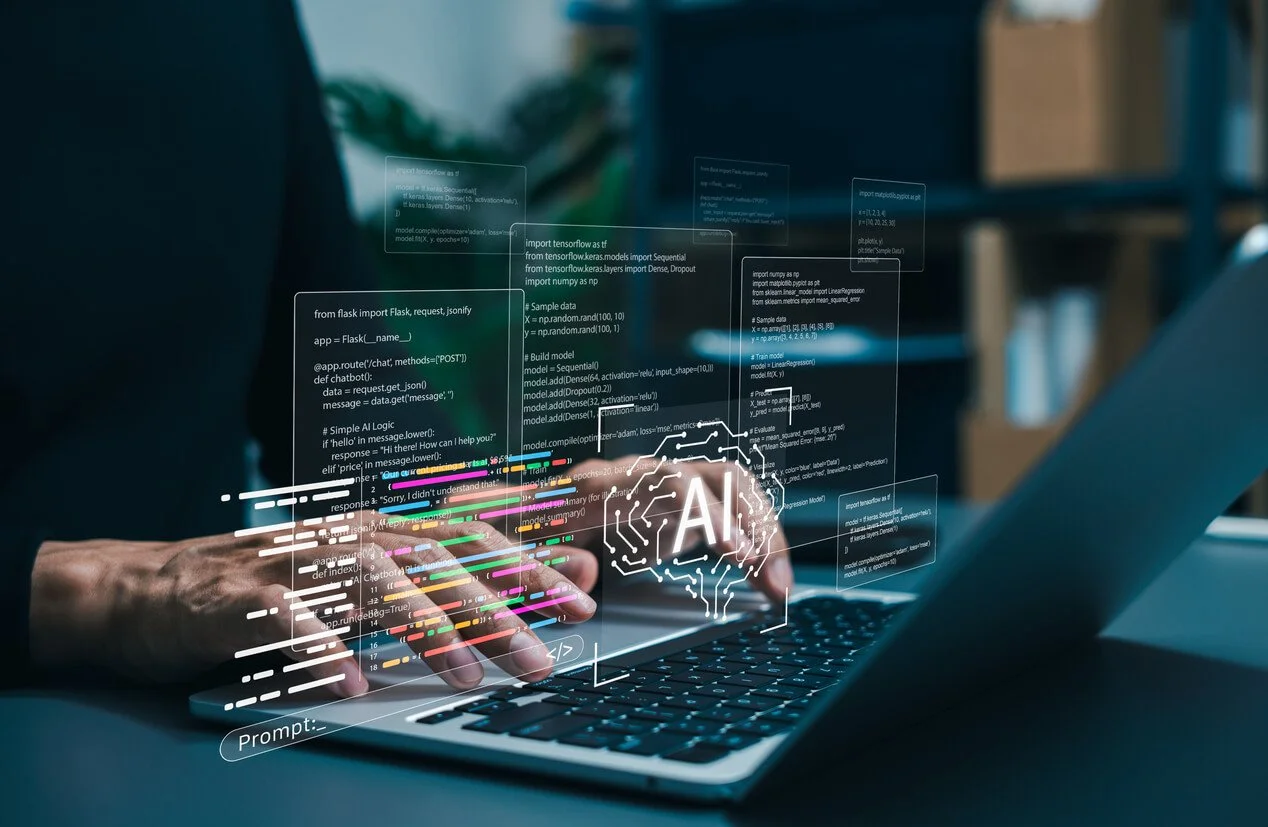
AI is transforming software development. Rather than replacing developers, AI software development tools accelerate coding, testing, debugging, and delivery, helping engineering teams build higher-quality software more efficiently.
The shift is already well underway. According to GitHub's 2024 Developer Survey, 92% of developers use AI coding tools at work or in their personal projects. Gartner also predicts that by 2027, 70% of professional developers will use AI-powered coding assistants daily, up from less than 10% in 2023. Organizations that embrace AI today position their engineering teams to deliver software faster and compete more effectively.
This article explores how AI is reshaping software development and testing, and why hiring developers with AI experience has become a growing priority for technology leaders.
How AI Is Changing Software Development
AI-Assisted Coding: What It Actually Looks Like in Practice
Tools like GitHub Copilot, Amazon Q, and Cursor sit directly inside a developer's environment and generate code suggestions in real time. Here's how that plays out in practice:
GitHub Copilot autocompletes functions, generates boilerplate, and drafts unit tests based on context from the current file and repository. Developers using Copilot complete tasks up to 55% faster, according to GitHub's own controlled study.
Amazon Q (formerly CodeWhisperer) integrates tightly with AWS infrastructure, making it particularly effective for teams building cloud-native applications. It also flags security vulnerabilities inline, specific to the AWS environment.
Cursor takes a different approach—it functions as a full AI-native code editor rather than a plugin. Developers describe what they want in plain language, and Cursor generates, edits, and refactors code across multiple files simultaneously.
The practical benefit goes beyond speed. Developers spend less time writing repetitive logic and more time solving the actual problems their software needs to address.
Code Review Assistance: Catching What Humans Miss
Manual code review is time-consuming and inconsistent. AI-powered review tools—such as those built into GitHub Copilot Enterprise or standalone products like CodeRabbit—scan pull requests and flag:
Logical bugs and edge cases
Security vulnerabilities (SQL injection, exposed credentials, outdated dependencies)
Style inconsistencies and code quality issues
Performance inefficiencies
Rather than relying on a senior developer to catch every issue, teams get a consistent first-pass review on every pull request. Senior engineers then focus on higher-order concerns: architecture decisions, business logic, and security posture.
Documentation Automation: The Work Nobody Wants to Do
Documentation is chronically neglected in most engineering teams—not because developers don't see its value, but because writing docs competes with shipping features. AI changes that equation. Tools like Mintlify and Swimm generate documentation directly from code, keeping it in sync as the codebase evolves. Engineers review and refine rather than write from scratch. The result is documentation that actually exists and stays current.
Developer Productivity: Where the Real Gains Show Up
The compounding effect of AI software development tools is significant. Developers spend less time on context-switching, fewer hours debugging trivial issues, and more energy on the creative and strategic work that actually requires a human mind. Stack Overflow's 2024 Developer Survey found that 81% of developers believe AI tools improve their overall productivity—with the largest gains in writing new code and understanding existing codebases.
AI Is Revolutionizing Software Testing
Testing is where AI delivers some of its most measurable and immediate value.
Automated Test Generation: Replacing Manual Scripting
Writing test cases is labor-intensive. AI tools like Diffblue Cover and Testim generate unit tests and integration tests automatically based on existing code. Diffblue Cover, for instance, analyzes Java code and writes JUnit tests without any human input. Teams that previously allocated weeks to test scripting reduce that timeline to hours.
This matters especially for legacy codebases that have little to no test coverage. AI provides a practical path to coverage that would otherwise require months of manual effort.
Smarter Regression Testing: Testing What Actually Matters
Traditional regression suites run every test every time—an approach that gets slower as codebases grow. AI-driven testing platforms like Launchable and Mabl analyze historical test data to identify which tests are most likely to catch failures based on what changed in the codebase. Teams run targeted subsets first, catching the highest-risk failures fast and running the full suite only when needed.
The practical result: shorter CI/CD pipelines, faster feedback loops, and fewer hours wasted waiting for test results.
Defect Detection: Finding Patterns Before They Become Bugs
AI systems trained on large codebases recognize patterns associated with defect-prone code—even when the code technically runs. Tools like DeepCode (now part of Snyk) and SonarQube's AI features flag these patterns during development rather than after deployment. Engineers fix issues before they ever reach a staging environment.
Predictive Quality Assurance: Shifting Left in a Meaningful Way
"Shift left" has been a testing philosophy for years. AI gives it real teeth. By analyzing deployment history, code change patterns, and system telemetry, AI models predict which releases carry elevated failure risk. Teams respond by adding targeted testing, slowing rollout, or reviewing specific modules before release. Quality assurance transforms from reactive problem-solving into proactive risk management.
Software Engineering Recruitment in the AI Era
Building a team with this skill profile presents a genuine challenge. The competition for engineers who combine strong fundamentals with AI experience is intense. Roles stay open longer. Candidates with the right profile receive multiple offers. And technology evolves faster than most internal talent acquisition teams track.
Software engineering recruitment has become specialized work. Tech staffing firms that focus specifically on engineering talent maintain current knowledge of the market—which skills are in demand, what compensation benchmarks look like, and where to find candidates who aren't actively applying to job boards.
Working with specialized tech staffing firms brings several practical advantages. These firms pre-screen candidates for both technical depth and AI tool proficiency. They reduce time-to-hire by presenting only qualified candidates. They understand the nuance between a developer who has used GitHub Copilot occasionally and one who has integrated AI tools into production workflows. For organizations that hire software developers at volume, or for hard-to-fill senior roles, that specialization pays off.
Internal recruiting teams that try to cover all roles across all technical disciplines often struggle to keep pace with how quickly the engineering skill landscape is evolving. Partnering with tech staffing firms focused on software engineering recruitment gives organizations access to expertise and candidate networks built specifically for this market.
Questions Technology Leaders Should Be Asking Right Now
Before closing, here are five questions worth bringing to your next engineering or leadership discussion:
Are our development teams actively using AI tools in their daily workflows—or just aware that these tools exist?
Do our engineers receive structured support or training for AI-assisted development?
Have we automated testing at the unit, integration, and regression levels where it makes sense?
When we hire software developers, are we screening for AI tool proficiency alongside core engineering skills?
Does our software engineering recruitment strategy reflect the skills the market actually demands today?
If the honest answer to most of these is "not yet," that's a gap worth closing deliberately.
The Future Belongs to Teams That Combine Smart Tools With Exceptional Engineers
AI software development is not a future trend—it's the current state of competitive engineering. The organizations pulling ahead are those that treat AI as infrastructure, build teams with the skills to use it well, and keep their software engineering recruitment strategy aligned with where the discipline is heading.
Development and testing are faster, smarter, and more automated than they were two years ago. That pace of change isn't slowing down. The teams built to thrive through it combine intelligent tooling with engineers who know how to direct, evaluate, and build on top of what those tools produce.
As AI continues reshaping software engineering, experienced developers and specialized recruiting partners play a central role in helping organizations build teams capable of delivering innovative, high-quality software at scale.
Ready to build a team equipped for the AI era? Contact us to find out how Recru connects organizations with the engineering talent they need.
Frequently Asked Questions
What is AI software development, and how does it differ from traditional software engineering?
AI software development refers to the practice of using AI-powered tools—such as GitHub Copilot, Amazon Q, and Cursor—to assist engineers across the software development lifecycle. Traditional software engineering relies entirely on human input for coding, testing, and documentation. AI software development integrates automation into these tasks, allowing engineers to work faster and focus on higher-complexity problems.
Will AI replace software developers?
No. AI tools handle repetitive, well-defined tasks like code generation and test scripting. Human engineers remain responsible for system architecture, business logic, security decisions, and user experience design—areas where judgment, context, and creativity are essential. AI elevates developer capability rather than substituting for it.
What skills should organizations prioritize when they hire software developers in 2024 and beyond?
Organizations that hire software developers now look for candidates who combine strong engineering fundamentals with proficiency in AI coding tools, cloud platforms (AWS, Azure, GCP), automated testing, and modern DevOps practices. The ability to critically evaluate AI-generated code is increasingly valued alongside core programming ability.
How do tech staffing firms help with software engineering recruitment in the AI era?
Specialized tech staffing firms maintain up-to-date knowledge of the engineering talent market, including which AI-related skills are in demand and where qualified candidates are concentrated. They pre-screen candidates for both technical depth and AI tool experience, reducing time-to-hire and improving the quality of matches for organizations competing for scarce engineering talent.
What AI tools are most widely used in software testing today?
Leading AI testing tools include Diffblue Cover (automated unit test generation for Java), Launchable (intelligent test selection and regression prioritization), Mabl (AI-driven end-to-end testing), and Testim (AI-powered test automation). These tools reduce manual scripting effort, accelerate CI/CD pipelines, and identify defects earlier in the development cycle.
Is AI software development suitable for all types of engineering teams?
AI development tools benefit teams across company sizes and tech stacks, though the specific tools and implementation approach vary. Startups often gain the most immediate productivity gains due to small team sizes and fast iteration cycles. Enterprises benefit particularly from AI's impact on legacy codebase management, documentation, and large-scale regression testing.

About Recru
Recru is an IT staffing firm built by industry professionals to create a better recruiting experience—one that puts contractors, clients, and employees first. We blend cutting-edge technology with a personalized approach, matching top tech talent with the right opportunities in contract, contract-to-hire, and direct hire roles. With offices in Houston and Dallas, we make hiring and job searching seamless, flexible, and built for long-term success. Find the right talent. Find the right job. Experience the Recru difference.